In the 2026 vintage season weather predictions have been difficult and outcomes quite variable across Central Otago.
The winter months of July and August were slightly warmer than average, though we still experienced plenty of the expected frost nights to help reset the vines for spring — that seemed a promising start to the season.
In late September a rare phenomenon: a Sudden Stratospheric Warming (SSW) (Read more) event developed over Antarctica. This occurs when an area of relatively warm air forms in the stratosphere above the South Pole — temperatures rising to just below 0°C instead of the usual -55°C. Such events disrupt normal weather patterns, often increasing the likelihood of extreme conditions such as strong winds, heavy rain, and cold outbreaks.
The weather we’ve experienced after 21 September reflected the influence of this SSW. Westerly winds were stronger and more persistent than usual throughout late September and October, and rainfall was more frequent. Fortunately, Grasshopper Rock, situated in the Alexandra Basin, lies further east than most other Central Otago subregions and is naturally sheltered from much of the wind and rain. Both rainfall and wind speeds tend to drop significantly as weather systems move east from the Southern Alps.
Another hallmark of SSW events is the occurrence of short, sharp southerly blasts pushing cold Antarctic air northward. We experienced one such event on 27–28 October, when temperatures remained below 7°C for 24 hours and snow fell to low levels. Frosts that might normally follow did not occur, thanks to the quick return of westerly winds and cloud cover.
A further atmospheric event: the Indian Ocean Dipole (IOD) (Read more) developed peaking at an extreme negative reading in November. An extreme not seen for many decades.
These two events (SSW & IOD) led to uncertainty in weather predictions and particularly temperatures which have been cooler than normal with many asking “where was the summer?”.
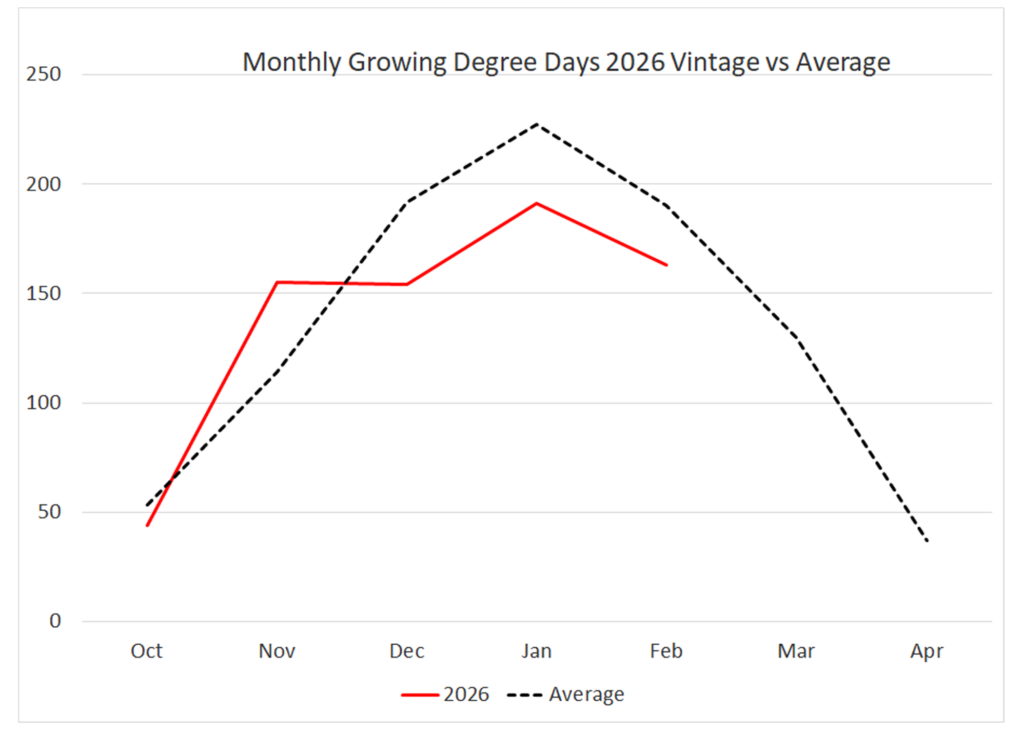
October temperatures were below average, and vine growth was approximately a week behind last year.
November temperatures increased with 26°C recorded on 4 November. November was warmer than normal
December was a month of two halves. The first two weeks temperatures averaged 16.1 degrees Celsius and the second two weeks temperatures lowered with southerly winds and averaged only 13.8 degrees. Fortunately, flower was all but over by 15 December which is reasonably early. Overall, the month shows on the chart as cooler than normal but hides the warm flowering period in the first two weeks of the month.
In January the cooler than normal weather continued.
February also continued cooler than normal. This means an accumulation of ten weeks of cooler than normal temperatures and a growing season where events like berry colour change and ripening are 1-2 weeks behind . Late but not too late!
Rainfall at Grasshopper Rock has been lower than normal. Total rain for October-February has been 172 mm. Compare this to vineyard weather stations in Bannockburn and Pisa recording 297 mm and 265 mm respectively. We normally see lower rainfall in the sub regions to the west but this year the difference is more dramatic than normal.
12 March 2026
The 2026 vintage marks 21 vintages of Grasshopper Rock