
The Old Man’s Breath: The Katabatic Wind of Grasshopper Rock
A katabatic wind is a downslope wind created when cool, dense air flows from higher ground into warmer, lighter air below. Because air density is strongly influenced by temperature, these winds are usually associated with colder air descending from mountains or elevated plateaus.
New Zealand’s best-known example is the Greymouth Barber. Having lived in Greymouth and cycled through the Barber many times, I can confirm it is both bitterly cold and remarkably localised. The phenomenon develops on calm mornings when cold dense air forms in the Grey Valley and drains toward the warmer coastal air around Greymouth.
What makes the Barber so visually spectacular is the landscape itself. As the cold air reaches Greymouth, not all of it can pass through the narrow gap in the hills, forcing some air over the ridge line where it condenses into an endless flowing cloud before evaporating again in the warmer coastal air. Once the valley warms later in the morning, the Barber disappears.
Similar katabatic cloud formations occur throughout mountain ranges around the world whenever cool dense air meets warmer air. They are most common in the morning or late afternoon when temperature differences — and therefore air density differences — are at their greatest.
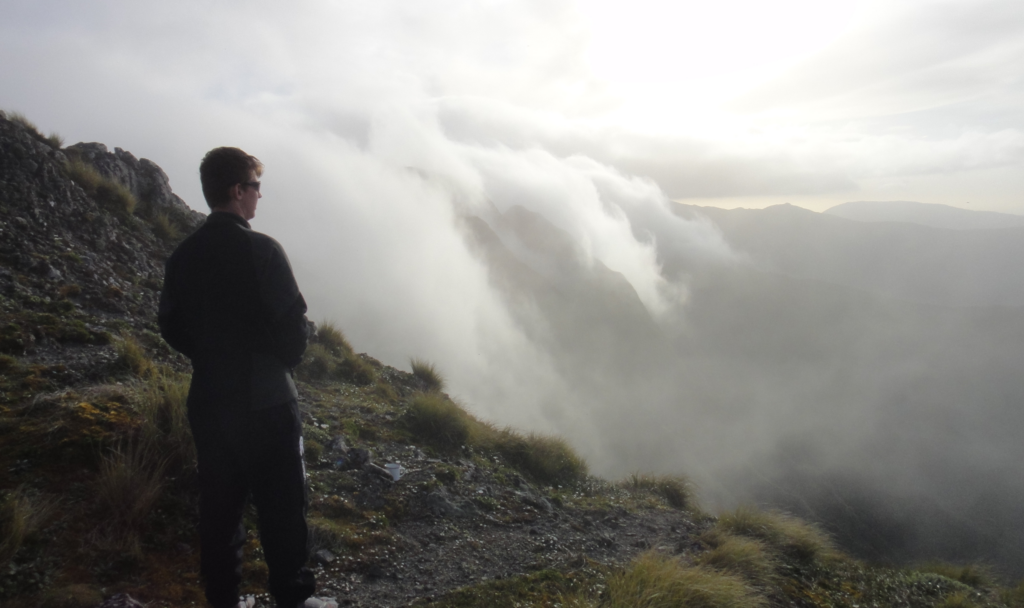
Landforms play a critical role in shaping these winds. The Greymouth Barber and similar formations in the Tararua Ranges are intensified because the surrounding terrain funnels the denser air through low points in the landscape. The image below is looking west at the Tararua Peaks on the main Tararua Range with the airflow from left to right – cool to warmer less dense air.
It is this same interaction between temperature, topography, and airflow that creates the katabatic wind at Grasshopper Rock.
We call it The Old Man’s Breath.
Named after the nearby Old Man Range from which it descends, The Old Man’s Breath is a highly localised southerly breeze that arrives on many summer afternoons at Grasshopper Rock. It typically begins in mid-afternoon and fades away during the evening.
Although not especially cold, it is cool enough to moderate the vineyard after the heat of the day. At times it can arrive with surprising force and gustiness — another consequence of the surrounding landforms that shape and accelerate the airflow.
What Creates The Old Man’s Breath?
Grasshopper Rock lies within the Alexandra Basin, a broad inland basin surrounded by high mountains. The vineyard itself sits in the southeastern corner of the basin at relatively low altitude, around 150–170 metres above sea level. With its northerly aspect and long sunshine hours, it is one of the warmest vineyard sites in the basin during summer.
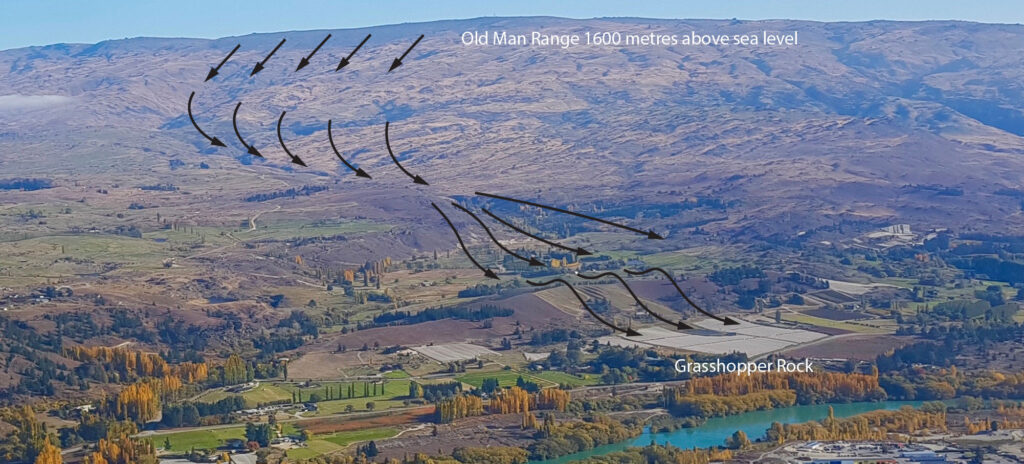
To the southwest rises the Old Man Range, reaching 1,600 metres above sea level within only 14 kilometres of the vineyard. Air temperature typically decreases by about 0.7°C for every 100 metres of altitude gain, meaning the summit ridge of the Old Man Range can often be around 10°C cooler than Grasshopper Rock on a summer afternoon.
This temperature difference creates a strong contrast in air density. During the day, warm air rises from the basin until it reaches equilibrium with the cooler denser air over the mountains. But as the afternoon sun moves westward, the eastern slopes of the Old Man Range rapidly cool. The dense air can no longer remain suspended and begins flowing downhill through the valleys.
This is the origin of The Old Man’s Breath.
The local topography then amplifies the effect. Air descending from the Old Man Range is channelled down the Conroy’s Creek valley, dropping more than 1,000 metres in elevation over a relatively short distance. By the time it reaches Conroy’s Dam, the airflow has accelerated and become increasingly confined by the surrounding hills.
From there, Grasshopper Rock lies directly in its path.
An east-west ridge immediately above the vineyard further influences the airflow, acting almost like an aerofoil. As the wind spills over the ridge, it creates downwash into the vineyard, increasing both wind speed and turbulence.
This is why The Old Man’s Breath can sometimes feel gusty — almost angry. Rather than flowing smoothly, the dense descending air often arrives in pulses and waves as it interacts with the warm air still rising from the basin floor.
Why It Matters for Pinot Noir
The Old Man’s Breath is an important part of summer life at Grasshopper Rock and a defining feature of the vineyard site.
By moderating afternoon temperatures, the wind slows the ripening process and reduces the impact of excessive heat. For Pinot Noir, this is critical. High temperatures can accelerate sugar ripening too quickly, often at the expense of flavour complexity and aroma development.
Long, slow ripening under intense sunlight and cool evening conditions produces greater balance, perfume, and detail in Pinot Noir. The Old Man’s Breath helps create exactly those conditions.
It is more than simply a local wind.
It is part of the identity of Grasshopper Rock — and part of the character of the wine itself.